
LVP vs Tile in AZ Kitchens: Which Wins for Durability & Style?
Choosing a new kitchen floor feels permanent, and in a busy Arizona home, the wrong choice is a costly mistake.
We can help you choose the best option for your space.
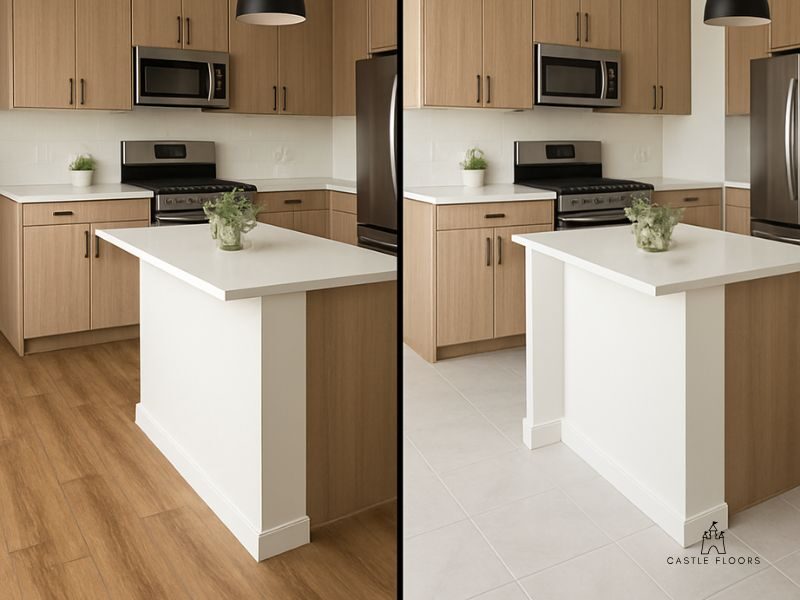
You see two front-runners in every showroom: the timeless, rock-solid appeal of tile and the modern, versatile look of Luxury Vinyl Plank (LVP). They both appear flawless under the store lights, but how will they hold up to your family’s daily chaos of spills, drops, and dragged chairs?
This decision often comes down to the LVP vs. tile debate. One is a champion of hardness, trusted for generations. The other is an engineered marvel designed for resilience and comfort. The “better” option depends entirely on whether your biggest concern is a dropped cast-iron skillet or your dog’s claws skittering across the surface after a trip to the backyard.
To settle the debate, we’ll compare them head-to-head on the factors that truly matter in a kitchen, water resistance, scratch durability, and impact survival, so you can choose with absolute confidence.
What Exactly Are LVP and Tile?
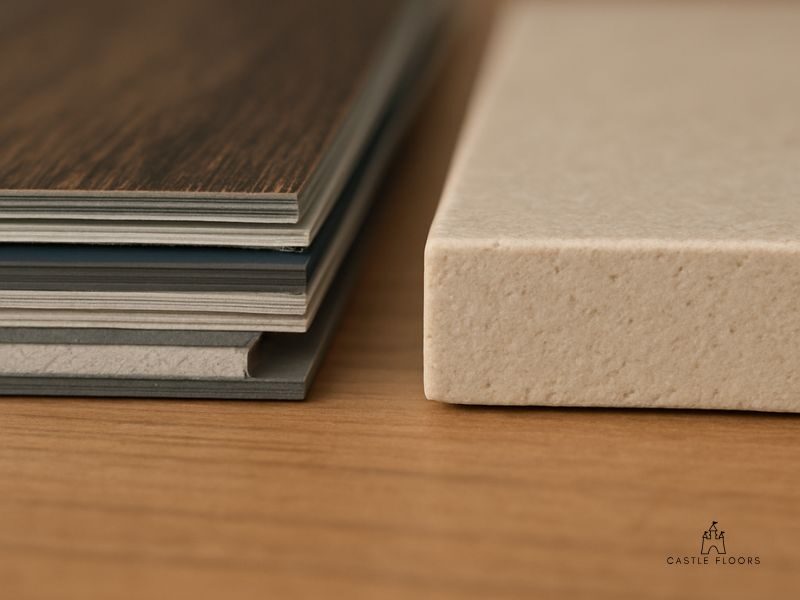
When you hear “vinyl,” you might picture the soft, peeling sheet flooring from decades ago. Luxury Vinyl Plank (LVP) is completely different. Think of it as a high-tech sandwich: a rigid core gives it strength, a hyper-realistic photo layer provides the wood or stone look, and a clear protective “wear layer” on top shields it from daily life. Each plank is a solid, individual piece that clicks together, a far cry from old-school roll-out vinyl.
On the other side is classic tile, which mainly comes in two flavors: ceramic and porcelain. While they can look similar, the key difference is density. Think of standard ceramic as being like a terracotta pot—strong, but slightly porous. Porcelain is made from finer clay and baked hotter, making it dense and tough like a coffee mug. This extra toughness and superior water resistance are why porcelain has become the standard for most floors, especially in kitchens and bathrooms.
LVP is an engineered product, a multi-layered plank designed for modern performance. Tile is a more natural material, a single, solid piece of earth fired into a state of rock-hard permanence. This core difference in construction—layered and flexible vs. solid and rigid—determines how they stand up to real-world challenges, starting with the most common one: water.
The Water Test: Which Floor Survives Spills and Leaks Best?
When you’re choosing a floor for a bathroom, kitchen, or laundry room, water is the number one enemy.
On this front, both LVP and tile are champions. The surface of a luxury vinyl plank and a porcelain tile are completely non-porous. A puddle from a bathtub overflow or a spilled drink can sit there for hours without ever soaking through the material itself.
However, true water resistance isn’t about the tile or plank itself, it’s about the seams between them. A floor is a complete system, and its weak point is always the seams. For tile, that means the grout lines, and this is where its otherwise perfect armor shows a chink.
By its nature, standard grout is porous. Unsealed, it acts a bit like a sponge, absorbing everything from mop water to spilled wine, which can lead to discoloration or mildew over time. While tile is a fantastic choice, keeping it truly waterproof requires that the grout is sealed after installation and then re-sealed every few years. This simple maintenance is crucial for longevity.
LVP, on the other hand, is built with tight, click-lock seams that leave almost no room for water to penetrate. When installed correctly, the planks form a highly water-resistant surface with minimal gaps, making it an excellent choice for a laundry room or basement. This near-seamless construction gives it a slight edge in the water war. But what happens when the floor is dry, and the challenge comes from pet claws and dragged chairs?
The Scratch Test: Who Wins Against Pet Claws and Dragged Chairs?
The daily grind of scooted chairs, pet claws, and dragged toys presents a different kind of durability challenge. A floor that can survive a flood might still look tired and scratched after just a year of family life. To understand how a floor holds up against surface wear, look at two key ratings that cut through the marketing hype.
For LVP, scratch resistance is all about its invisible shield: the wear layer. Think of it as a transparent, heavy-duty screen protector for your floor, and its thickness is measured in mils. A thicker wear layer provides more protection against scratches and scuffs. For tile, the equivalent measure is the PEI rating, a simple 1-to-5 scale that tells you how well the tile’s surface resists abrasion and chipping from foot traffic.
For a durable floor in a home with kids or pets, look for these minimums:
- For LVP: Look for a wear layer of 12 mil or higher. For homes with large dogs or lots of activity, 20 mil offers fantastic peace of mind.
- For Tile: Look for a PEI rating of 3 or 4. Anything in this range is designed to handle all residential foot traffic with ease.
While a high-quality LVP is incredibly tough, the fundamental winner for scratch resistance is porcelain tile. Its fired, rock-hard surface is simply more difficult to physically scratch than LVP’s protective topcoat, making it some of the most scratch-resistant flooring for pets. However, that impressive hardness brings its own vulnerability. What happens when the threat isn’t a light scratch, but a heavy impact from a dropped pot?
The Impact Test: What Happens When You Drop a Heavy Pot?
This is where tile’s greatest strength, its rock-hard surface, becomes a potential weakness. Think about a ceramic coffee mug: it’s incredibly hard, but if you drop it, it shatters. Ceramic and porcelain tile behave the same way. Because the material is so rigid and brittle, a sharp impact from a dropped can of soup or a heavy pan has nowhere to go. This often results in a permanent chip or crack, revealing the limits of its impact and crack resistance.
Luxury vinyl plank, on the other hand, handles impact with flexibility. Its core is designed to give slightly under pressure, which is part of what makes it more comfortable to stand on. When that same pot lands on an LVP floor, the material absorbs some of the force. So, does LVP flooring dent easily? While a severe impact can certainly leave a dent, the floor is far less likely to crack or shatter. The damage is more often a cosmetic imperfection than a structural failure.
The choice comes down to which flaw you’d rather live with. A dent in LVP is often a subtle divot that you might not even notice, and the floor’s surface remains sealed and safe. A cracked tile, however, creates an immediate and often sharp flaw that can trap dirt and water. This difference becomes critical when considering longevity and repairs.
Longevity and Repairs: Which Floor is Easier to Live With?
On paper, tile easily wins the longevity marathon. A professionally installed porcelain or ceramic floor can last for 50 years or more, making it a potentially permanent feature of your home. By comparison, you can expect a high-quality LVP floor to look great for 15 to 25 years. However, when real-life accidents happen, the focus shifts from a floor’s total lifespan to how realistically you can repair the damage.
Fixing a single cracked tile is a surprisingly involved and often dusty process. It requires carefully chiseling out the broken piece, scraping away the hardened mortar underneath, and then setting a replacement. The biggest headache is often matching the old grout color, which can make the patch obvious. Because of the required tools and skill, replacing a cracked tile is often a costly professional job.
Repairing LVP, on the other hand, is significantly more straightforward. If you wisely saved a few extra planks from your installation, a damaged board can often be popped out and a new one clicked into its place. There’s no grout to match, no mortar to mix, and no dust cloud to clean up. For many, it’s a quick fix that makes the floor look new again in under an hour.
This raises a crucial question about long-term ownership and maintenance. Do you prefer a floor with an incredible potential lifespan that’s difficult to repair, or one with a shorter—but still very long—life that’s simple to patch up? Your answer depends on your lifestyle, budget, and how much you value peace of mind over a “forever” material.
Your Final Choice: Which Floor Is Right for Your AZ Kitchen?
You’re no longer just looking at flooring samples; you’re seeing two different philosophies of durability. Where you once saw a simple choice between wood-look and stone-look, you can now visualize how each surface will handle a dropped pot, a skittering pet, or a flooded laundry room. This knowledge transforms your decision from a guess into a deliberate choice based on how your family truly lives.
To make that final call, here’s a clear breakdown:
Choose Tile if…
- You prioritize maximum scratch resistance and longevity above all else.
- You want a classic, rock-solid feel and don’t mind periodic grout sealing.
- Your budget allows for professional repair of any potential cracks.
Choose LVP if…
- You have active kids or pets and worry more about dropped items than deep scratches.
- You prioritize a softer, warmer feel underfoot and a simpler repair process.
- You want a highly water-resistant floor for a kitchen or bath with minimal maintenance.
The debate over LVP vs. tile durability isn’t about finding the one “toughest” floor, it’s about choosing the right kind of tough for your home. You’re deciding between the unyielding hardness of rock and the resilient flexibility of a tire.
Now, you can confidently choose the floor that won’t just survive your high-traffic areas, but will actively make your life easier for years to come.
Still not sure what to pick? Get in touch with our team today, we offer unbeatable expertise, selection and design services.